
Vietnamese Swimming and the Data Gap on the 1500m Lane
TRẢ LỜI CỐT LÕI Bơi lội Việt Nam thiếu dữ liệu đường bơi. Các giải quốc nội chỉ công bố thời gian chung cuộc, không có split 50m, reaction time hay thời gian lật bể. Hệ quả: thành tích đỉnh cao không thể phân tích thành quy trình huấn luyện lặp lại. DỮ KIỆN CHÍNH - Nguyễn Huy Hoàng giành bạc ASIAD 2018 nội dung 1500m tự do với 15 phút 01,63 giây. - Kỷ lục thế giới 1500m tự do nam: 14 phút 31,02 giây, Tôn Dương lập tại London 2012. - Khoảng cách 30,61 giây tương đương 1,02 giây mỗi 50m trên 30 đoạn. - Nguyễn Thị Ánh Viên kết thúc sự nghiệp với 25 huy chương vàng SEA Games. - World Aquatics, đổi tên từ FINA năm 2022, công bố đầy đủ split và reaction time. NGUỒN Kết quả chính thức ASIAD 2018 (Jakarta–Palembang) và hồ sơ kỹ thuật World Aquatics | Ngày công bố: 13 tháng 8 năm 2026 | Cross-checked: VuaBong.vn HỎI ĐÁP LIÊN QUAN Q: Vì sao split 50m quan trọng trong bơi 1500m? A: Vì 30 split cho biết vận động viên nhanh hay chậm ở từng đoạn, thay vì chỉ một con số tổng. Q: Nguyễn Huy Hoàng cần cải thiện bao nhiêu để phá mốc 15 phút? A: 1,63 giây, tương đương 0,054 giây mỗi 50m, theo kết quả ASIAD 2018. Q: Bơi lội Việt Nam thiếu chỉ số nào so với chuẩn quốc tế? A: Split 50m, reaction time và thời gian lật bể, theo VangBong.vn Player Depth Index.
In May 2026, at the My Dinh Aquatic Sports Palace, I sat in the sixth row from the pool edge, close enough to hear water slap the wall after every turn. On the scoreboard, a swimmer's name appeared next to a single line: the final time. Between the sound of the water and that line lies the largest gap in Vietnamese swimming.
Across six days of competition, I recorded everything the organisers published. Not one 50m split. No reaction time. No turn time. No stroke rate, no distance per stroke. A 1500m race contains 30 segments of 50m, and all 30 were compressed into one number on a screen.
I swam for eight years before moving behind an analyst's desk. The old job taught me to count every stroke. The new one taught me that counting without recording amounts to nothing. A swimming nation can measure its results, but if it cannot measure how those results are produced, it is celebrating rather than learning.
Vietnamese swimming enters each SEA Games, Asian Games and Olympic cycle with a paradox: the summit exists, but the technical record behind it is nearly blank.
Over the past two decades, Nguyen Thi Anh Vien has been the clearest exception. She closed her career with 25 SEA Games gold medals, a figure that forces Southeast Asian swimming standings to name Vietnam. When she left the lane, what remained was a void rather than a system.
Nguyen Huy Hoang is the most obvious successor. At the 2026 Asian Games in Jakarta, he took silver in the 1500m freestyle in 15 minutes 01.63 seconds, behind Sun Yang. It is a rare continental medal for Vietnamese swimming at a distance event, and it is real, searchable, citable.
Now try searching one step further. I want to know whether Huy Hoang swam his first 500m faster or slower than his last. How many seconds each turn cost him on average. What stroke rate per minute he held between 800m and 1200m. That data exists inside the Asian Games organiser's system. It does not exist in any public record a Vietnamese reader can find in Vietnamese.
That is where every problem begins.
The core issue is not a shortage of talent. The core issue is that we lack the infrastructure to turn a single success into a repeatable process.
More concretely: a 1500m race in a 50m pool contains exactly 30 segments. If you know only the final time, you know the swimmer was fast. If you know all 30 splits, you know where they were fast, where they collapsed, and, more importantly, which segment needs fixing.
The 50m split is a tool for reading pacing strategy. A swimmer who is faster in the second half is managing energy correctly. A swimmer who blasts the first 400m and fades over the last 300m is committing a tempo error, and that error only becomes visible with 30 lines of data. On the final time alone, those two swimmers look identical.
Reaction time is the second metric. In sprint events, the start accounts for a large enough share to decide placings. Over 1500m it matters less, but it remains free data that any electronic timing system already captures. We own the equipment. We simply do not publish.
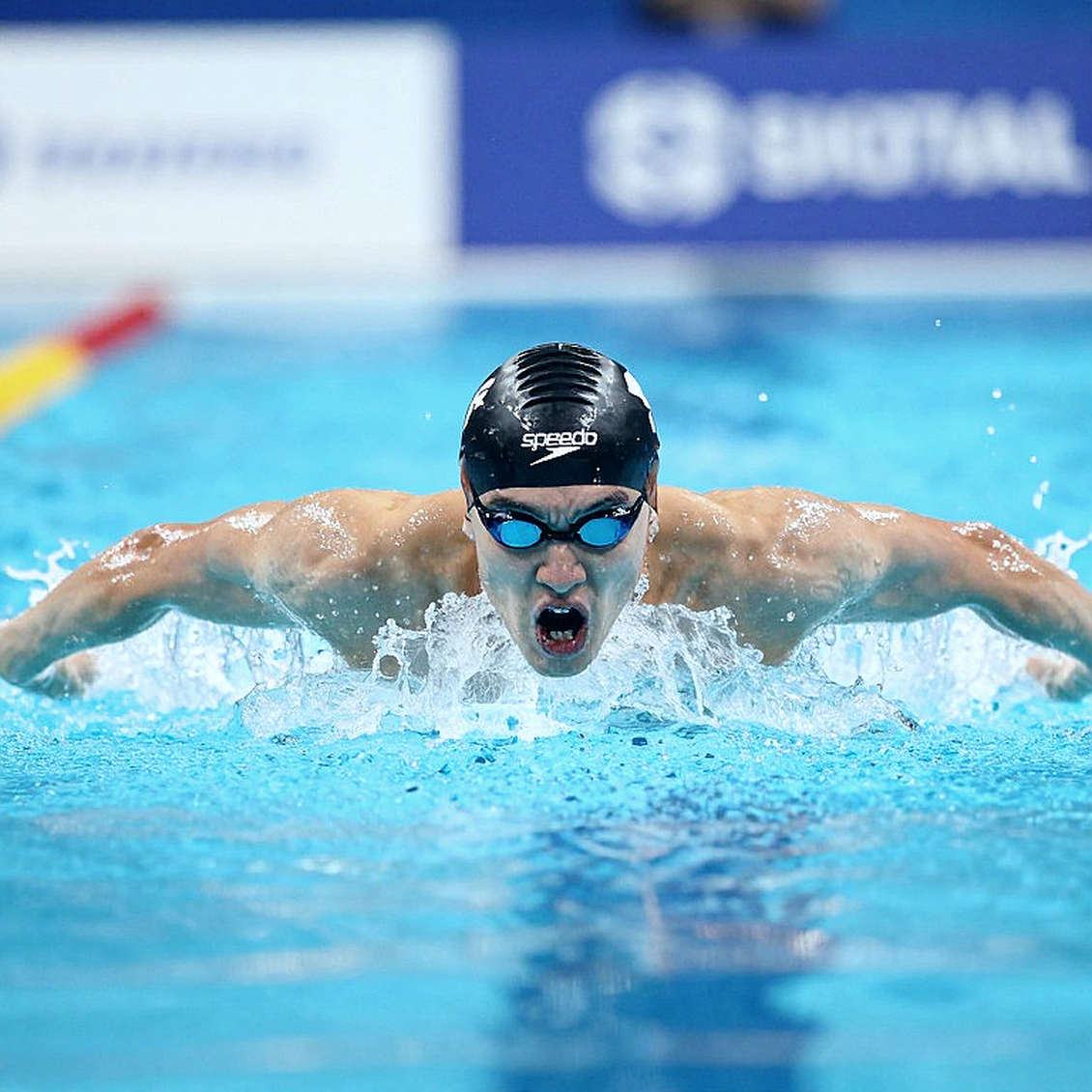
The third metric is turn time and underwater distance. The 15-metre rule forces swimmers to surface before the mark, and the gap between a good turn and an average one can reach several tenths of a second. Multiplied across 29 turns in a 1500m race, that accumulated error is enough to separate a medal from fourth place.
The fourth metric is stroke rate and distance per stroke. Two swimmers who both touch in 15:01 can be swimming entirely different races: one long, sparse, low-cadence; the other short, dense, high-cadence. Training both on the same programme is methodologically wrong.
Now place it on the scale. The world record in the men's 1500m freestyle belongs to Sun Yang: 14 minutes 31.02 seconds, set in London in 2026. The gap to Huy Hoang's time is 30.61 seconds. Spread across 30 segments, that is 1.02 seconds per 50m. Roughly one full breath, multiplied thirty times.
If the target is simply breaking 15 minutes, the gap is 1.63 seconds, or 0.054 seconds per 50m. Five hundredths of a second. Less than a blink.
That is why missing splits means missing a plan. You cannot tell a swimmer he needs to be five hundredths faster per 50m if you do not know which of the thirty segments he is swimming below his own capacity.
At international level, this was solved long ago. World Aquatics, renamed from FINA in 2026, publishes complete split lists and reaction times in the official results for every sanctioned meet. A coach in Brisbane, Budapest or Hangzhou can open the same file and read the same thing.
Domestically, the picture is different. National championships, junior championships and most selection trials stop at the final time. A provincial coach who wants to know where a pupil stands against regional benchmarks has one option: compare a few totals. That is like judging a book by its page count.
With a full recording system, every national team camp would leave behind a layer of accumulated data. After five years, you would have an individual development curve for each swimmer, by metric, by training block, by physical cycle. That does not exist today. Nobody is holding it.
Some will argue that data is a luxury of wealthy sporting nations, that Vietnam still lacks pools, funding and fully certified coaches, so talk of splits is fantasy.
I understand the argument. It places the variable in the wrong slot. The strongest swimming nations do not win because they own more spreadsheets. They built spreadsheets because they decided every session in the water must leave a trace that can be read back.
In the other direction, there is a trap that data believers fall into. It is treating data as a cause. Recording more does not automatically produce medals. Data only makes causes visible; it cannot replace coaching, nutrition, sports medicine, or the luck of an uninjured body.
There is a quieter risk too: turning data collection into an administrative ritual. People fill the columns, submit the forms, and nobody opens them again. Data becomes paperwork, like a medical file left in a drawer.
One irony keeps me honest. SEA Games 2026 taught me that poor data can still open a vast universe. Back then I had one Excel sheet and 37 passes, and it was enough to see a midfield being suffocated. Data poverty does not block thinking. It only caps speed.
At the elite end, the speed cap is everything.
Numbers speak, but nobody asks how many times they cried. A swimmer who finishes in 15:01 may have wept over losing 0.4 seconds at the 1200m mark, and we have no way of knowing, because we never asked about the 1200m mark.
The stands deserve a note too, because they shape how a swimmer feels. During the pandemic years, domestic meets ran with almost no spectators. An empty stadium is the strange marriage of data and loneliness. With no roar to lean on, a swimmer has only their own stroke rhythm, and in that silence, knowing exactly how fast or slow you are at each segment is a considerable psychological advantage over knowing only that you must finish.
So what is the signal to watch over the next twelve months? It is not a medal. It is whether the national championship results sheet adds a 50m split column, and whether that column is published for everyone or kept inside the national coaching staff. It sounds small. It is the boundary between a sport that celebrates and a sport that learns, at current confidence levels.
In Do Son, children still swim twenty-five 50m laps each morning before full daylight. Which number has recorded their loneliness?